Monday, October 14, 2013

Tom and Huck: Two Sides of Twain


A running theme in Twain’s life is one of duality.  In two previous posts I have examined ways in which this duality plays out in his life.  The relationship between Tom and Huck is another example of the duality in Mark Twain and the tension that is causes in his life.  Twain patterned Tom Sawyer after himself as a boy and while Huckleberry Finn was supposedly patterned after a boyhood friend of Twain, Huck, especially in The Adventures of Huckleberry Finn, has connections to Twain as an adult and alludes to conflicts that Twain experienced in his later life.  

Tom and Huck are complete opposites.  Tom is a romantic; he is imaginative, sociable, innovative, and adaptable.  Tom is a leader among his peers and understands his reality through a series of highly fantastical situations and play.  He is constantly acting out various scenarios based on books he has read and this type of play allows him to be someone that his normal life couldn’t allow him to be.  Huck on the other hand is a realist; he doesn’t like people to tell him what to do, he is independent, intelligent, but ignorant.  Huck seems to easily trust Tom and follows Tom’s lead in their interactions.  These differences are qualities that Twain seems to possess himself, a realist but interested in a fantasy world, resistant to “silivization,” as Huck would put it, but readily moving throughout society.  He is very critical of the world around him and questions the foundations of the society that he lives him, much like Huck. 
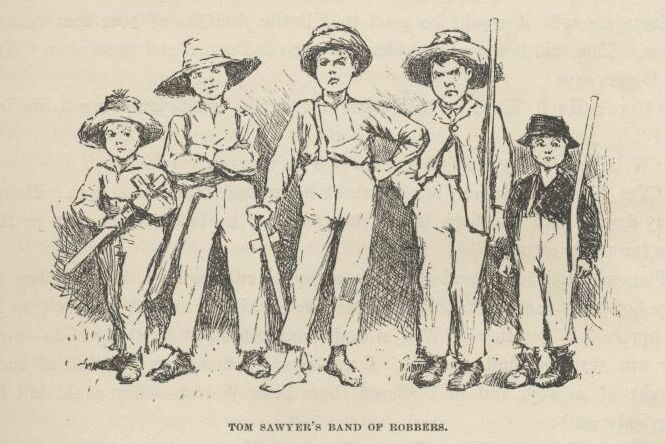
The tensions caused by the duality Twain experiences come out in the exchange between Tom and Huck in chapter three of The Adventures of Huckleberry Finn.  Tom has gathered the boys together and set up a secret society of robbers based, of course, on a book that he has read.  Tom sets the rules for these robbers and makes sure the boys are adhering to these rules.  After about a month of pretending to be robbers many of the boys, including Huck, quit the gang.  Huck seems disappointed that they “hadn’t robbed nobody, [they] hadn’t killed any people, but only just pretended” (18).  Huck’s naïve and realistic understanding of the world caused him to not be able to play along with the game that Tom was creating.  Instead he believes that the world Tom is setting up is real; they will really rob and kill people.  When Huck approaches Tom about his “lies,” Tom insults Huck, not once but twice, calling him ignorant and a “perfect slap-head” (20, 19).


Twain is presenting a disturbing look at the duality he is exploring through Tom and Huck. The two boys, the two sides, are at war with each other.  It seems destined that one should over power the other, and perhaps the end Twain wrote for this book shows just that. Huck seemingly goes back on his conscious and follows Tom in his plot to free Jim, a plot that further degrades Jim and seems to cancel out any change he made earlier in the book.

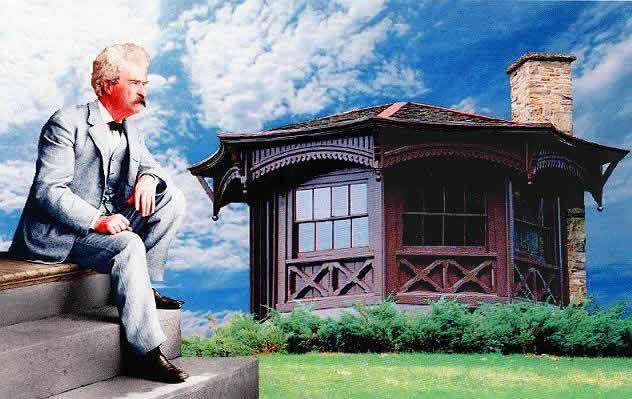
Marianne Cord and Nigger Jim: Parallels Between The Life of Samuel Clemens and The Adventures of Huckleberry Finn


In my previous post “Two Fathoms or Safe Water: Mark Twain’s Pen Name,” I talk about Twain’s dual personality as a “southerner and a northerner” afforded him a unique world view and understanding of people.  This duality could be a good thing but Ken Burn hints that it may be a source of inner discontent with Twain.  According to Burns, Twain was afraid of the extent of his own prosperity.  Though Burns never goes into depth about his fear, he does draw connections between Twain’s fear and the duality in his life.  This is perhaps because the wealth and notoriety he gained moved him further from his southern roots and the life he understood as a boy.  This move was brought to his attention keenly by Marianne Cord, a servant at Quarry Farm and a former slave.  One evening Twain remarked to Cord that she “can’t have had trouble” in her life because her eyes were always laughing and he never heard her sigh.  She responds to this by telling Twain her life story, a story that would continue to have a profound influence on Twain for many years to come.


Born a slave, Cord eventually married and had seven children.  Because they were slaves, her family was broken up and sold to various other owners.  When they came for her last son, Henry, he tried to run away and proclaimed that he was going to buy their freedom.  Cord clung to Henry and cried desperately “you shan’t take him” (qtd in Burns).  Years later Cord was approached by a young man, she took one look at the young man and “all the sudden [she] know’d” it was her son Henry that she had lost.  She was over joyed that she “got [her] own again” (qtd in Burns). This story never left Twain, it reminded him, a slave owners son living in a post-emancipation America, of the realities of slavery and the difficult life that many still lived.  That summer Twain began working on The Adventures of Tom Sawyer, a story that eventually led to The Adventures of Huckleberry Finn, a complex book trying to deal with the world he lived in and the world he lives in now. 
 
In The Adventures of Huckleberry Finn, Huck and Jim – a slave – are on the river and Huck sees Jim mourning for the children he left behind.  In this moment Huck realized that Jim “cared just as much for his people as white folks does for ther’n” and then comments that “it don’t seem natural, but “he reckon[s] it’s so” (Twain 239).  This is a profound moment in Huckleberry Finn where a young boy realizes that Jim is a man with the complex emotions and 3-deminsional character like any man.  This realization is a huge leap for Huck and goes against everything he had been taught to know about slaves and about Jim. 

This moment in The Adventures of Huckleberry Finn hearkens back to the exchange with Marianne Cord and Huck’s realization mirrors Twain’s own realization about the complexities of the society he lived in.  Twain didn’t try to idealize the realities he was presenting; instead he laid this realization at the feet of America and asks them to see the tough circumstances and choices slaves lived with. 

Wednesday, October 2, 2013

Glittering Gold Part 2: Tom Sawyer as a Man of Gold

Mark Twain’s gold mining adventures in Nevada taught him a valuable lesson, “nothing that glitters is gold” and that it is human nature to “go on underrating men of gold and glorifying men of mica” (Twain Travel 59).  This revelation stuck with Twain throughout his life and showed up in his writings.  In The Adventures of Tom Sawyer, Twain highlight young Tom Sawyer and his friends as “men of gold” (59). 

Twain exposes the idea that these young boys can be men of gold through the innocence of childhood and exploration of youth as a condition rather than a period of time.  In Twain’s story about Tom Sawyer there is a running theme that idealized childhood and the purity and innocence that exists in it. Twain depicts many instances where this is best seen.   Two that stand out as example of an idealized childhood are when Tom convinces the local boys to paint his fence and the superstitions that the boys cling to as a religion. 

Tom manages to convince his friends and the boys in town to help him paint his fence, pay him for the pleasure of doing it, and thoroughly enjoy the work.  Tom does this by exaggerating his work on the fence and painting it “with the eye of and artist” brushing “ daintily back and forth” and “criticizing the effects” as if it were a fine piece of art rather than a chore (Twain 16, 17).  This catches the eye of Ben, Tom’s first victim, and in return for being able to whitewash Tom’s fence Ben gives him his apple.  Boy after boy follow in Ben’s footsteps, paying Tom for the pleasure of painting the fence with whatever “treasure” they have available.  These treasures come in the form of fragments of chalk, a dog-collar, pieces of orange-peel, and so on.  The act of painting the fence and the treasures used to pay for the opportunity show the innocence of youth because they are themselves innocent and simple.  In childhood the simplest thing shave worth, and imagination allows the dullest of pastime become adventures in art.  Twain shows that gold comes in the form of boys, their simple activities, and the things they value. 
In the second example, Twain shows how superstitions have been perpetuated, and how the children come to create a religion around these superstitions.  Tom runs into Huckleberry Finn one morning, and Huck is carrying a dead cat.  The two boys strike up a conversation about the proper method for getting rid of warts.  In one superstition, a boy much stick his hand in stump water and recite an incantation; in another superstition, the boy must have a dead cat in a graveyard at midnight and throw it while reciting a different incantation.  Both rituals, though different, play a part in the religion the children have set up.  For them these rituals are as real, or more real, than the adult, Christian religion they are forced to endure.  There is an innocence and purity about these rituals because they have not grown out of forced attendance and recitations, but out of imagination and life.  The children clearly put more stock in this religion than they do Christianity.  They respect the home-grown “gold” and wisdom that exists in them. 


Through Tom Sawyer, Mark Twain attempts to point out the innocence of childhood and make his adult readers nostalgic for a time and place that would allow for the exploration of the world and human nature in a way that is unique to childhood.  He shows that “men of gold” are not always men and the perhaps the loss of childhood turns men from gold to mica.  

Two Fathoms or Safe Water: Mark Twain's Pen Name

Having spent time as a steamboat captain, Samuel Clemens was intimately familiar with the term that later became his pen name.  According to the Mark Twain biography by Ken Burns, mark twain marks the line between safe and dangerous waters for a steamboat.  The term twain means two fathoms or twelve feet deep; mark twain was called out when the water twelve feet deep under the boat. His time as a steamboat captain was a pivotal point in his life; the river carved a path through him and left an indelible mark on his character.  He chooses his pen name when he began writing his adventures out west.  The first time he penned a piece as Mark Twain he was in Nevada working with a group of newsmen that lived an adventurous “proto-psychedelic” life (Burns).  His life was on the edge of safe and dangerous; shortly after taking on his pen name he fled Nevada to escape a dual he was sure he was going to lose.

His choice of pen name shows a duality that existed in his life.  As Samuel Clemens he was from small river-town, as Mark Twain he was a renowned writer and orator.   He ran to the west with his brother after a short stint in the civil war; he spent his time in the west living on the edge of civilization and observing every part of life on the edge.  Twain was a “southerner and a northerner; a westerner and a New England Yankee; a tireless wanderer, who lived in a thousand places all around the world” (Burns).  Twain’s experiences afforded him a unique view of people and the world.  Burns describes Twain as a “noticer” saying that he observed people: the way the dressed, their mannerism, their speech, and their pretentions.  From his observations, Twain wrote, and his in his writing he “spok[e] for the American people” (Burns). If Twain was a speaker for the American people, then the pen name Mark Twain represented Clemens’s life and late 19th Century America.  He was not using a pseudonym to hide his identity, but rather to reveal a part of his identity, and to comment on America as he saw it. 


Mark Twain represents a person and an idea about America.  Twain saw what America was and what American could be; he saw it as sitting on the edge of safe and dangerous waters and dedicated his writing to showing America as he saw it.