Friday, December 6, 2013

The Mysterious Stranger and Twain's Thoughts about Life, Death, and God


The death of a child is never an easy thing for any parent to go through, including Samuel Clemens.  On the heels of the death of Susie Clemens, Samuel Clemens attempted to make sense of life and of death through his work as Mark Twain.  Throughout his life, as evidence through his work and his interaction with his wife Livy and various others, Twain has struggled with religion and the God of the Bible.  His story, The Mysterious Stranger, is one of many works that attempt to grapple with these ideas.  One scene at the beginning of The Mysterious Stranger sets up this struggle to understand religion, life, and death.  Satan, an angel builds a clay people then sets them in motion to live life as if they were human.  Satan even allows the children that he meets to help him build clay people – crippled and poorly made people. As soon as the people were made the “went diligently to work and cleared and leveled off a space a couple of yards square in the grass and begun to build a cunning little castle in it”(61).  In other words, they went about their little lives “as natural as life” (61).  Twain uses Satan and these clay people as a metaphor for how he views our relationship with the God of the Bible, if there was one. 
The narrator says of Satan’s behavior and thoughts of humans that we are “of paltry poor consequence; often you would think he was talking about flies, if you didn’t know” (63).  In this he sets Satan, and God, up as a character that is above the everyday existence of humanity.  Our actions, our feelings, and our lives are of no consequence to the characters Twain has created in his story and by extension of the metaphor, to God.   The narrator later says the Satan spoke of humanity in a “matter-of-course way and without bitterness, just as a person might talk about brick or manure or any other thing that was of no consequence and hadn’t feelings” (61).  The children even get wrapped up in his enchantments; they forgot everything while they reveled in the stories Satan told them.  At one point the children even laugh of when Satan had brought to life two of the worst clay people and they moved about as if they were drunk.  Their humanity was still intact, however.  They are upset when Satan crushes the poorly made clay people and he said that it didn’t matter because more can be made.  At the end of the small clay lives, Satan causes a storm and an earth quake the swallows up all the clay people.  Satan ends the lives he created with no second thought and no remorse. 
Twain’s life had been marked by several senseless and difficult to handle deaths, including the death of two of his children by this point.  Twain sees God as a figure above humanity, willing to play with lives, uncaring, and remorseless when human tragedies happen.  This worldview is no surprise coming from a deeply conflicted and cynical man with a keen eye for observation.

Thursday, December 5, 2013

Mark Twain on Imperialism and America


     Mark Twain’s travels allowed him to have a unique perspective on America’s influence and presence in the world.  It also gave him insight into imperialism and international relations.  His thoughts on the matter are very explicitly stated in his essay “To Person Sitting in Darkness.”   He introduces the “people sitting in darkness,” as he sardonically calls anyone America has deemed uncivilized, by saying that they have been “furnished with more light than was good for them or profitable for us. We have been injudicious” (Twain, 269).  Twain uses this metaphor to introduce the supposed gifts that capitalism and imperialism offers to uncivilized and colonized nations.  Among those gifts are: love, justice, law and order, equality, mercy, and liberty – “gifts” that civilization exports but does not necessarily practice.  He says that these gifts are “merely an outside cover … while inside the bale is the Actual Thing that Costumer Sitting in Darkness buys with his blood and tears and land and liberty” (270).  A heavy price to pay for any supposed gifts. 
     Twain uses this metaphor of a person sitting in darkness to satirize America’s interactions abroad but also to call into question America.  While he wrote this he drew, not only on his experience abroad but his experience at home. His works, including this essay are woven with keen observations about American life and values in the 19th century.  Through his work, like “To the Person Sitting in Darkness,” Twain examines Jim Crowe Laws, class relations, the KKK, and various other things sitting in darkness in American society.  By pointing out the prettily packaged “Americanism” that is being sold abroad and creating a metaphor of bringing light to other, Twain is bringing light to topics that America has ignored and ideals that America has betrayed.  His outrage at the betrayal of principles happening in America is played out in his outrage about the “friendly” and “affectionate” betrayal that happens abroad, like in the Philippines.  His comments on the matter reflect what he saw closer to home:  “for we were only play the American Game in public” (276).  America, as well as the Filipino’s, are being “petted” and lied to.  The freedoms’ that American’s “enjoyed” at home were not real freedoms and that many Americans experienced no freedoms at all. 
      Like much of his work, Twain uses “To the Person Sitting in Darkness” to comment on more than what is on the surface.  He passes harsh judgment on the America of his time, both the prettily wrapped exported America, and the dark, harsh America in the beautiful package.  His work asks his readers to open their eyes and minds to the harsh realities around them and to respond.  Twain’s keen observations show a dark side to America in contrast to the happy childhood that his readers saw in work such as Tom Sawyer. 

Monday, November 11, 2013

Identity, Morality, and the One-Drop Rule in Pudd'nhead Wilson


In Pudd’nhead Wilson, Mark Twain explores morality as it is tied to identity, slavery, and the “one-drop” rule.   Written on the heels of Plessey v Ferguson, Pudd’nhead Wilson looks at the lives of Roxy, a slave, her son Valet de Chambers, and their owner’s son Tom Driscoll.  Roxy was “to all intents and purposes… white as anybody” (14).  However, because she was one sixteenth black the 15 parts white in her were “outvoted” and “she was a slave, and salable as such” (14).  Her son Valet de Chambers has a white father and as such is only one thirty-second black despite the fact that he “had blue eyes and flaxen curls like his white comrade,” and that not even “the father of the white child was able to tell the children apart” (14).  In a moment of crisis, fearing that her child could be easily sold down the river, Roxy switches the two boys, because of they looked identical no one noticed the change, after all people could only tell them apart because of their clothing.  As easily as changing clothing the slave became the master and the master became the slave.  Roxy had to go on with a perfect behavior towards the two so that the fiction she created could continue.  Eventually her repeated lies became real, permanent parts of her internal psyche: “the forms soon concreted itself in habit’ it became automatic and unconscious” (28). Roxy had allowed her deception to become so ingrained that it was no longer a deception; “the mock reverence became real reverence” and Roxy’s child was no longer her child but her “master and deity” (28).   The former Valet de Chambers and now Thomas a Beckett Driscoll grew up to be the master, he lorded over his former master and mother, he became a bully and coward, he received fine schooling, and he lived his life with no one the wiser that he had been born a slave until his mother told him who he was.  After this revelation Tom experienced a paradigm shift, his entire world was rocked and the sudden knowledge that he had one drop of black blood changed his perspective on everything.  Suddenly, without any actual changes occurring other than the knowledge of who he was born to, he was struck with the horror that he was “a nigger.”  His behavior didn’t change but his perspective on his behavior did, suddenly his “low places he found lifted to ideals, some of his ideals had sunk to valleys,” he justified his bad behavior – stealing, for example – as the “nigger in him” (69).  With this realization he suddenly was “afraid to enter and sit with dreaded white folks on equal terms” (69).  The belief that blacks were naturally inferior was so ingrained in the culture of the time that Tom couldn’t help but let the “nigger in him assert its humility” (69).  Through the character of Tom, Twain satirizes the “tradition” that simultaneously cannot be legislated but that was legislated in Plessey v Ferguson. 

Friday, November 8, 2013

The Volcano Allegory

In A Connecticut Yankee in King Arthur's Court, Mark Twain uses the allegory of a volcano to explore social, economic, political and technological change.  Hank, after establishing his utopia, declares that “unlimited power is the ideal thing when it is in safe hands”, the safe hand being his of course.  He considered himself to be a "despot” and the “perfectest individual of the human race” because he had managed to have the “civilization of the nineteenth century booming under its very nose.”  He compared this civilization to a volcano waiting to erupt:  “There it was, as sure a face, and as substantial a fact as any serene volcano, standing innocent with its smokeless summit in the blue sky and giving no sign of the rising hell in its bowels” (48).  His analogy proved to be more apt that he thought; by the end of the book thirteen gatlings (created by Hank and his factories) would “vomit death into the fated ten thousand” and “within ten short minutes after [they] had opened fire, armed resistance was totally annihilated” (264).  By the end of the battle “fifty-four were masters of England! Twenty-five thousand men lay dead” around them (264).  Hank’s reign as “the Boss” ended just as he predicted: a volcanic eruption that destroyed everything in its way. 
                Through this allegory Twain explores his conflicting ideals about capitalism.  Twain was a collector of new technologies.  He was the first to have a telephone in his home, he sank his money into various technologies including the Paige Compositor  (a printing press that used a mechanical arm to set type but that failed because it’s numerous errors),  and was supposedly the first person to write a book on a typewriter.  In Connecticut Yankee, Twain sets Hank, an ordinary man in the 19th Century, in the 6th Century where he can become extraordinary.  He soon sets himself above those around him and his lust for power drives him to create technologies that the 6th Century morals are not yet able to handle.  Though Hank, Twain explores his own fears that technology will outstrip morals and that abused technology will provide the type of “ultimate power” that ends with the volcanic eruption that ends Hank’s stay in King Arthur’s court. 

Monday, October 14, 2013

Tom and Huck: Two Sides of Twain


A running theme in Twain’s life is one of duality.  In two previous posts I have examined ways in which this duality plays out in his life.  The relationship between Tom and Huck is another example of the duality in Mark Twain and the tension that is causes in his life.  Twain patterned Tom Sawyer after himself as a boy and while Huckleberry Finn was supposedly patterned after a boyhood friend of Twain, Huck, especially in The Adventures of Huckleberry Finn, has connections to Twain as an adult and alludes to conflicts that Twain experienced in his later life.  

Tom and Huck are complete opposites.  Tom is a romantic; he is imaginative, sociable, innovative, and adaptable.  Tom is a leader among his peers and understands his reality through a series of highly fantastical situations and play.  He is constantly acting out various scenarios based on books he has read and this type of play allows him to be someone that his normal life couldn’t allow him to be.  Huck on the other hand is a realist; he doesn’t like people to tell him what to do, he is independent, intelligent, but ignorant.  Huck seems to easily trust Tom and follows Tom’s lead in their interactions.  These differences are qualities that Twain seems to possess himself, a realist but interested in a fantasy world, resistant to “silivization,” as Huck would put it, but readily moving throughout society.  He is very critical of the world around him and questions the foundations of the society that he lives him, much like Huck. 

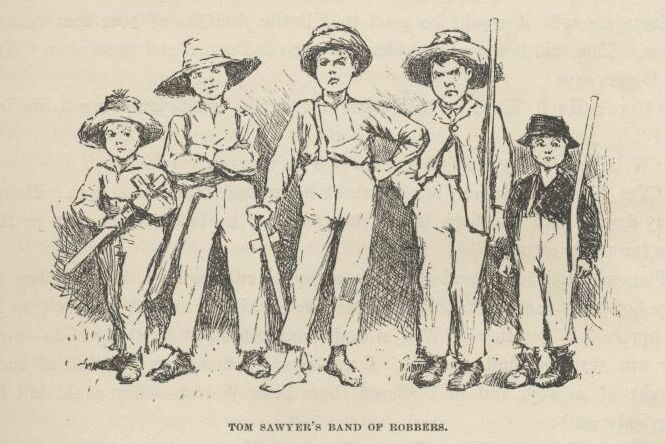
The tensions caused by the duality Twain experiences come out in the exchange between Tom and Huck in chapter three of The Adventures of Huckleberry Finn.  Tom has gathered the boys together and set up a secret society of robbers based, of course, on a book that he has read.  Tom sets the rules for these robbers and makes sure the boys are adhering to these rules.  After about a month of pretending to be robbers many of the boys, including Huck, quit the gang.  Huck seems disappointed that they “hadn’t robbed nobody, [they] hadn’t killed any people, but only just pretended” (18).  Huck’s naïve and realistic understanding of the world caused him to not be able to play along with the game that Tom was creating.  Instead he believes that the world Tom is setting up is real; they will really rob and kill people.  When Huck approaches Tom about his “lies,” Tom insults Huck, not once but twice, calling him ignorant and a “perfect slap-head” (20, 19).


Twain is presenting a disturbing look at the duality he is exploring through Tom and Huck. The two boys, the two sides, are at war with each other.  It seems destined that one should over power the other, and perhaps the end Twain wrote for this book shows just that. Huck seemingly goes back on his conscious and follows Tom in his plot to free Jim, a plot that further degrades Jim and seems to cancel out any change he made earlier in the book.

Marianne Cord and Nigger Jim: Parallels Between The Life of Samuel Clemens and The Adventures of Huckleberry Finn


In my previous post “Two Fathoms or Safe Water: Mark Twain’s Pen Name,” I talk about Twain’s dual personality as a “southerner and a northerner” afforded him a unique world view and understanding of people.  This duality could be a good thing but Ken Burn hints that it may be a source of inner discontent with Twain.  According to Burns, Twain was afraid of the extent of his own prosperity.  Though Burns never goes into depth about his fear, he does draw connections between Twain’s fear and the duality in his life.  This is perhaps because the wealth and notoriety he gained moved him further from his southern roots and the life he understood as a boy.  This move was brought to his attention keenly by Marianne Cord, a servant at Quarry Farm and a former slave.  One evening Twain remarked to Cord that she “can’t have had trouble” in her life because her eyes were always laughing and he never heard her sigh.  She responds to this by telling Twain her life story, a story that would continue to have a profound influence on Twain for many years to come.


Born a slave, Cord eventually married and had seven children.  Because they were slaves, her family was broken up and sold to various other owners.  When they came for her last son, Henry, he tried to run away and proclaimed that he was going to buy their freedom.  Cord clung to Henry and cried desperately “you shan’t take him” (qtd in Burns).  Years later Cord was approached by a young man, she took one look at the young man and “all the sudden [she] know’d” it was her son Henry that she had lost.  She was over joyed that she “got [her] own again” (qtd in Burns). This story never left Twain, it reminded him, a slave owners son living in a post-emancipation America, of the realities of slavery and the difficult life that many still lived.  That summer Twain began working on The Adventures of Tom Sawyer, a story that eventually led to The Adventures of Huckleberry Finn, a complex book trying to deal with the world he lived in and the world he lives in now. 
 
In The Adventures of Huckleberry Finn, Huck and Jim – a slave – are on the river and Huck sees Jim mourning for the children he left behind.  In this moment Huck realized that Jim “cared just as much for his people as white folks does for ther’n” and then comments that “it don’t seem natural, but “he reckon[s] it’s so” (Twain 239).  This is a profound moment in Huckleberry Finn where a young boy realizes that Jim is a man with the complex emotions and 3-deminsional character like any man.  This realization is a huge leap for Huck and goes against everything he had been taught to know about slaves and about Jim. 

This moment in The Adventures of Huckleberry Finn hearkens back to the exchange with Marianne Cord and Huck’s realization mirrors Twain’s own realization about the complexities of the society he lived in.  Twain didn’t try to idealize the realities he was presenting; instead he laid this realization at the feet of America and asks them to see the tough circumstances and choices slaves lived with.